Clause density: α ≈ 4.26 — conditions critical Price: ₹0 · Curiosity accepted Late edition

The ShunyaBar Dispatch

“Never claim optimal without proof.”

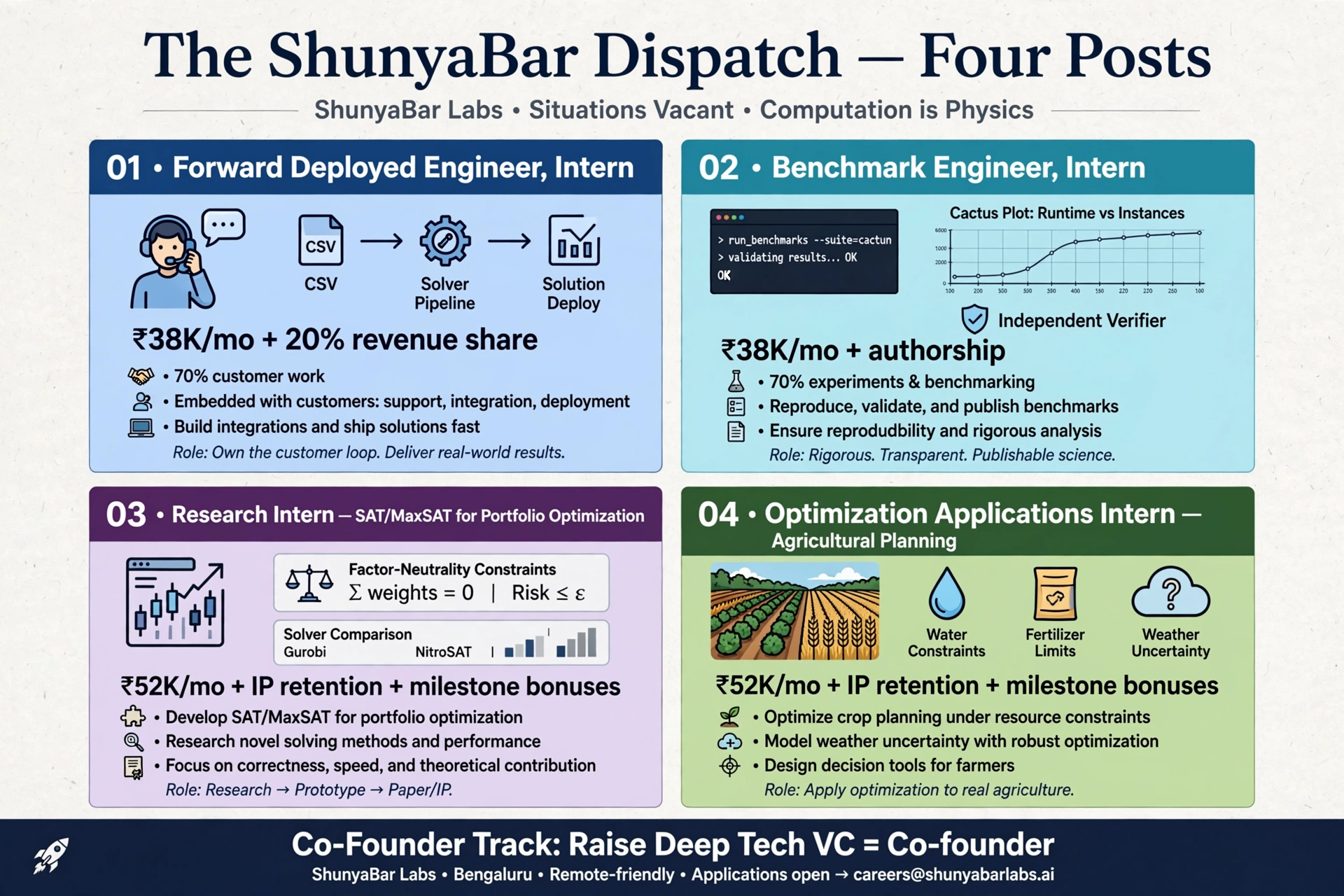
ShunyaBar Labs open roles — Forward Deployed Engineer, Intern and Benchmark Engineer, Intern — summarized as a single visual summary.
Open Roles · Four Posts · Read On

ShunyaBar Labs is a deep-tech research lab that builds decision engines for operational planning — the difficult scheduling, allocation, and verification problems that organizations otherwise solve with spreadsheets, overtime, and hope. Its foundation is a family of quantum-inspired SAT and MaxSAT solvers: NitroSAT, an open-source engine that has reported 99%+ satisfaction across thousands of formulas, some running to tens of millions of clauses; and Navokoj, the hosted product built on top of it.

The research is unusual, and the lab is unusually honest about it. Its public notebook explores everything from phase transitions to novel encodings, but its benchmark pages disclose failures alongside wins — a planted instance that stalled one clause short of perfect is left visible, not quietly recorded as solved. In an industry of confident demos, the house rule is stranger and stricter: write an independent checker; do not trust the solver's word.

The Bottleneck Has Moved

The lab's own assessment is blunt. Solver research is no longer the constraint. The constraint is everything around it: finding one real operator with a recurring problem, deciphering the cursed spreadsheet, modelling rules the operator actually recognizes, and earning enough trust to convert an evaluation into a paid pilot. Customers do not arrive carrying pristine CNF files and a handwritten objective function. Somebody has to go get the problem.

Hence this notice. The lab is hiring four graduates — one to carry the technology outward to customers, one to establish inward, in public and against the strongest available baselines, exactly where it stands, one to push the research frontier itself, by compiling highly-constrained portfolios into MaxSAT and benchmarking the result against the strongest commercial solvers money can buy, and one to apply the same engine to real operational domains, starting with crop-allocation planning under water, fertilizer, and weather uncertainty. All four work directly with the founder. All are governed by the same editorial standard as this newspaper's motto, printed above the fold.

The Window Is This Quarter

The physics works. The notebooks are public. The evidence corpus ships with hashes. What's missing is the loop — operator to invoice, invoice to benchmark, benchmark to next operator. That loop doesn't close with one hire. It closes with four, sitting in the same room, arguing about the same CSV. Miss this quarter and the compounding starts a quarter later. Make it now and the flywheel is real: every pilot funds the next benchmark, every benchmark shortens the next sale, every sale hardens the solver. That's the bet. And it's why the founder's calendar is open to all four posts, not just the FDE.

Market Data · The Intern's Ledger

Beyond the stipend, Forward Deployed hires earn a deal bonus on every contract they close. The arithmetic is printed in full, as arithmetic should be — and the upper bound is printed too, so neither party is surprised.

Bonus = min(10% × Deal Value, ₹60,000)  ·  50% on signing + 50% on pilot completion  ·  capped per calendar month
Worked examples, as published by the lab — all figures are one-time bonus, on top of monthly stipend
Deal ClosedBonus Paid (that month)All-in Comp That MonthCap Notes
₹1,00,000₹5,000 signing₹43,000₹5K completion tranche later
₹3,00,000₹15,000 signing₹53,000₹15K completion tranche later
₹6,00,000₹30,000 signing₹68,000₹30K completion tranche later; cap applies
₹12,00,000₹30,000 signing₹68,000₹60K total bonus; capped

Hard upper bound: the deal bonus never exceeds ₹60,000 in any single calendar month. The lab's max all-in cost for the FDE seat is therefore ₹98,000/month (₹38K base + ₹60K cap) when signing and a prior completion tranche coincide.

The Public Record

What the lab has actually shipped, published, and disclosed — verifiable by any reader

Assets on the Books

NitroSAT Open Source
Quantum-inspired SAT/MaxSAT engine. Reported across 5,000+ CNF instances: 77% perfect, 99.7% median satisfaction.
Streaming V3 Open Source
Bounded-memory solver that streams CNF/WCNF from disk — a reported 37-million-clause stream handled in under 10 MiB of solver memory. Hard vs soft semantics, feasibility reported separately from cost.
Navokoj Hosted Product
The commercial engine in Nano, Mini, and Pro tiers — measurably different behavior per tier, with Pro reporting a 92.57% perfect-solve rate on its published campaign.
Evidence Corpus Hugging Face
A ~595 MB public dataset: raw result JSONs for every engine tier, the CNF archive, solver logs and solutions, MD5 hashes, and join tables — published for audit, not applause.
Research Papers Zenodo
A public research portal of 14+ articles spanning constraint solving, spectral methods, and adaptive optimization — openly labelled an evolving lab notebook, exploratory where it is exploratory.

Editor's note: the runs above are self-reported by the lab, largely on generated instances, pending a standardized head-to-head against the field's best solvers. Building that independent comparison is, verbatim, the job description of Post No. 2 below.

Perks · In Black And White

Perk Normal Intern ShunyaBar FDE
Cash₹15–25K₹38K
Upside0.01% equity = lotteryup to ₹60K deal bonus = cash, capped
ToolsVSCodeMinimax + H100 SSH
OfficeYour bedWeWork reimbursed
OutputJira ticketZenodo co-authorship + P&L
AccessAPI keySlack with founder debugging Lambert W at 11am

Situations Vacant

Four posts · ₹38,000–₹52,000 per month · Remote-first, India · IST overlap expected

Post No. 1 · Outward-Facing

Forward Deployed Engineer, Intern

₹38,000/mo · ₹10,000 M1 milestone + ₹15,000 M3 milestone · 4 months · ~70% sales, ~30% engineering · deal bonus: 10% of deal value, capped at ₹60,000/mo

Wanted: a sales-first graduate who'd rather pick up the phone than open an IDE, to close the gap between a technically impressive platform and its first paying customer. This seat is the company's sales engine first and an engineering support function second. You will find one operator with a painful, recurring constraint problem, run discovery, build the smallest ugly prototype that proves the solver works on their real problem, and convert the evidence into a signed paid pilot — or kill the wedge honestly.

The Work
  • Cold outreach: build a list of named operators with recurring constraint problems; get past the gatekeeper
  • Run discovery calls; capture workflows, mandatory rules, and failure modes
  • Build customer-shaped prototypes: CSV → model → solver → CSV — small enough to ship in a week, ugly enough to be honest
  • Scope the pilot, price it, negotiate terms, close the contract
  • Map the customer's alternatives — spreadsheets, incumbent software, Gurobi, OR-Tools, Timefold/OptaPlanner, Nextmv, or specialist tools — and state precisely where Navokoj is and is not a fit
  • Run Navokoj / NitroSAT with recorded commands, seeds, and outputs
  • Sit with users while they use it; note where trust breaks; verify every result with an independent checker
Qualifications Sought
  • Essential: comfort with cold calls, follow-ups, and saying "no" politely; willingness to be on customer calls every day; strong written English; basic Python; comfort with APIs, JSON, CSV and messy data; basic constraint-solving concepts (CP-SAT, OR-Tools, or coursework suffices)
  • Desirable: prior B2B sales or SDR experience; exposure to healthcare, logistics, manufacturing or workforce planning; Git, Linux, Docker
The Four-Month Progression
  • Month 1 — find the person: one named operator, one documented workflow, a written evaluation commitment
  • Month 2 — build the ugly prototype the operator can run and correct
  • Month 3 — run the real-data loop; document the decision: continue, rescope, or stop
  • Month 4 — convert evidence into a signed paid pilot, or discontinue the wedge with proof

Paid milestones: ₹10,000 at M1 for a named operator, documented workflow, and signed evaluation commitment; ₹15,000 at M3 for the real-data loop and a continue/rescope/stop decision. Deal bonus: 10% of deal value, capped at ₹60,000 per calendar month, split 50% on signing and 50% on pilot completion.

Who should not apply Those wanting three months of pure algorithm research, those who need fully specified requirements before building, and those who optimize for GitHub stars over customer outcomes. The lab says so itself, in writing.

Strategic responsibility: do not sell novelty in the abstract. Show the operator why a verified, general-purpose solver is better for this specific workflow than the incumbent or a mature domain tool.

Post No. 2 · Inward-Facing

Benchmark Engineer, Intern

₹38,000/mo · ₹40,000 M4 milestone + ₹40,000 reproduction bonus · 4 months · ~70% experiments, 30% write-ups

Wanted: a graduate with statistical nerve, to run the controlled bake-off these solvers have never had. You will build the harness, the baselines, the ablations, and the independent verifier — then publish the results in public, losses printed with the same ink as wins.

The Work
  • Baseline harness: Kissat, CaDiCaL, YalSAT/ProbSAT, NuWLS-c, Open-WBO, OR-Tools CP-SAT — same machine, same budgets, same semantics
  • Ablation suite: prime weights vs uniform, spectral preconditioning off, adaptive triggers vs fixed restarts — which components earn their keep?
  • Instance curation: SAT Competition main track, MaxSAT Evaluation incomplete track, non-planted random 3-SAT near the critical density, and a known-UNSAT calibration set
  • Competitive baselines: compare fairly against relevant exact, heuristic, and domain-specific systems — including Gurobi, OR-Tools/CP-SAT, Timefold/OptaPlanner, Nextmv, and specialist solvers where applicable
  • An independent clause-by-clause verifier; no result counts until it passes
  • Per-run artifacts: commit hash, instance hash, seeds, raw logs, verifier output
Qualifications Sought
  • Essential: strong Python and bash on Linux; CNF/WCNF literacy; statistical discipline — seeds, medians and IQR, never best-of-N; can build third-party solvers from source; will publish losses plainly
  • Desirable: SAT Competition / MaxSAT Evaluation familiarity (PAR-2, track rules); Docker; a good hand with quality-vs-time curves and cactus plots
The Four-Month Progression
  • Month 1 — harness and verifier: reproducible runner, pinned environments
  • Month 2 — baselines and instance sets under 60s / 300s / 3600s budgets
  • Month 3 — ablations: separate the kernel from the decoration
  • Month 4 — publish: PAR-2 scores, anytime curves, full artifact bundle; concede the lost fights, claim the defensible niche

Paid milestones: ₹40,000 at M4 for the complete hashed artifact bundle; ₹40,000 when an independent third party reproduces the headline results from the published artifacts, payable up to 12 months after the internship.

Who should not apply Those who would rather a benchmark flatter the house solver than describe it. The entire value of this post is that the numbers survive an adversarial reader.

Strategic responsibility: turn the evidence bundle into a defensible product claim. No “no one else does this” language without a documented market search; no speed claim without matched budgets, baselines, and verified outputs.

Post No. 3 · Research-Facing

Research Intern — SAT/MaxSAT for Quantitative Portfolio Optimization

₹52,000/mo · ₹25,000 preprint + ₹25,000 acceptance + ₹1,00,000 evaluation + ₹2,00,000 license · 4 months · Remote, India · IST overlap expected

A research-heavy engineering role at the intersection of SAT/MaxSAT, quantitative finance, and operations research. You will help turn NitroSAT into the discrete decision engine for highly-constrained portfolio construction — and benchmark it head-to-head against Gurobi, CPLEX, SCIP, and greedy baselines.

What you'll work on
Stipend & Rewards

₹52,000/mo base · co-authorship on every paper, preprint, technical report, or open-source release derived from the work · IP retention — the intern retains independent IP for anything they build that the lab doesn't directly fund; the lab receives a non-exclusive license for internal use.

Performance milestones: +₹25K on public preprint/submission · +₹25K on acceptance · +₹1L per public benchmark result accepted at a recognized evaluation · +₹2L per commercial license when the first invoice clears within 12 months post-internship.

Maximum milestone stack: ₹3,50,000.

Post No. 4 · Applied Research

Optimization Applications Research Intern — SAT/MaxSAT for Agricultural Planning

₹52,000/mo · ₹25,000 preprint + ₹25,000 acceptance + ₹1,00,000 evaluation + ₹2,00,000 license · 4 months · Remote, India · IST overlap expected

A domain-grounded research role at the intersection of SAT/MaxSAT, operations research, and real-world resource allocation. You will turn the messy, irregular constraints of crop planning — water, fertilizer, labor, rotation rules, market risk — into weighted Boolean optimization models, and benchmark NitroSAT against MIP, CP-SAT, and local-search baselines on a public benchmark suite.

What you'll work on
Stipend & Rewards

₹52,000/mo base · co-authorship on every paper, preprint, technical report, or open-source release derived from the work · IP retention — the intern retains independent IP for anything they build that the lab doesn't directly fund; the lab receives a non-exclusive license for internal use.

Performance milestones: +₹25K on public preprint/submission · +₹25K on acceptance · +₹1L per public benchmark result accepted at a recognized evaluation · +₹2L per commercial license of the agricultural-planning compiler when the first invoice clears within 12 months post-internship.

Maximum milestone stack: ₹3,50,000.

Four roles, not because the lab is large — it isn't — but because the company it is becoming has four jobs that must be done in the same quarter or the loop doesn't close. The FDE finds the operator whose 3 a.m. phone call is the company's first invoice. The Benchmark Engineer writes the public receipt that no competitor can argue with. The Research Intern pushes NitroSAT into the frontier no commercial solver has crossed — portfolio construction under factor-neutrality, sector caps and turnover. The Optimization Applications Intern carries the same engine into a real operational domain, starting with crop allocation under water, fertilizer, labor and weather uncertainty. Strip any one of these and the others stall: a solver with no frontier loses its proof, a frontier with no operator loses its customer, a customer with no independent benchmark loses its trust. We hire them together so they learn each other's work, not just their own. That is why these four.
Sethu IyerFounder & CEO, ShunyaBar Labs · on why these four posts
Solve one operator's problem, verify the solution honestly, and document everything so the next evaluation is faster.
— The core technical principle, all four posts
India's mid-market hospitals, third-party logistics firms, and semiconductor fabs run over ₹100Cr of constraint problems every year — nurse rosters, lot dispatch, route planning, capacity allocation. Almost all of it still runs on Excel and OR-Tools. When Navokoj cuts solve time 10× and ships the proof, you don't need a marketing budget. You need one FDE to find the operator who's sick of 3am phone calls, and one Benchmark Engineer to publish the receipts so the next FDE walks in faster. That's the company we're building.
Sethu IyerFounder & CEO, ShunyaBar Labs

Notice to Applicants

There are no portals and no forms. Write a plain email. The lab reads applications on a rolling basis, and there are exactly four posts — when they are filled, this notice comes down.

The heart of your application is 8–12 lines describing something you built for a real user:

  1. What problem they had
  2. What you built
  3. What broke
  4. What you changed
  5. What happened after they used it

Attach a CV, LinkedIn, or GitHub, and state your availability. Optionally include a small script or notebook — for Post No. 1, one that turns a roster CSV into a solution; for Post No. 2, one that runs a solver on a CNF and independently verifies the output. Any reasonable approach is fine; the thinking matters more than the algorithm.

Fresh graduates are explicitly welcome. The requirement is not experience — it is honesty, speed, and the willingness to be in the room.

House References · For the Curious Reader

A public resources drive — slides, recordings, and supporting material about ShunyaBar Labs, hosted on Google Drive. Open to all readers.